Screen-free play
Why screen-free matters most before five
What screens actually cost children under five, and what to do instead.

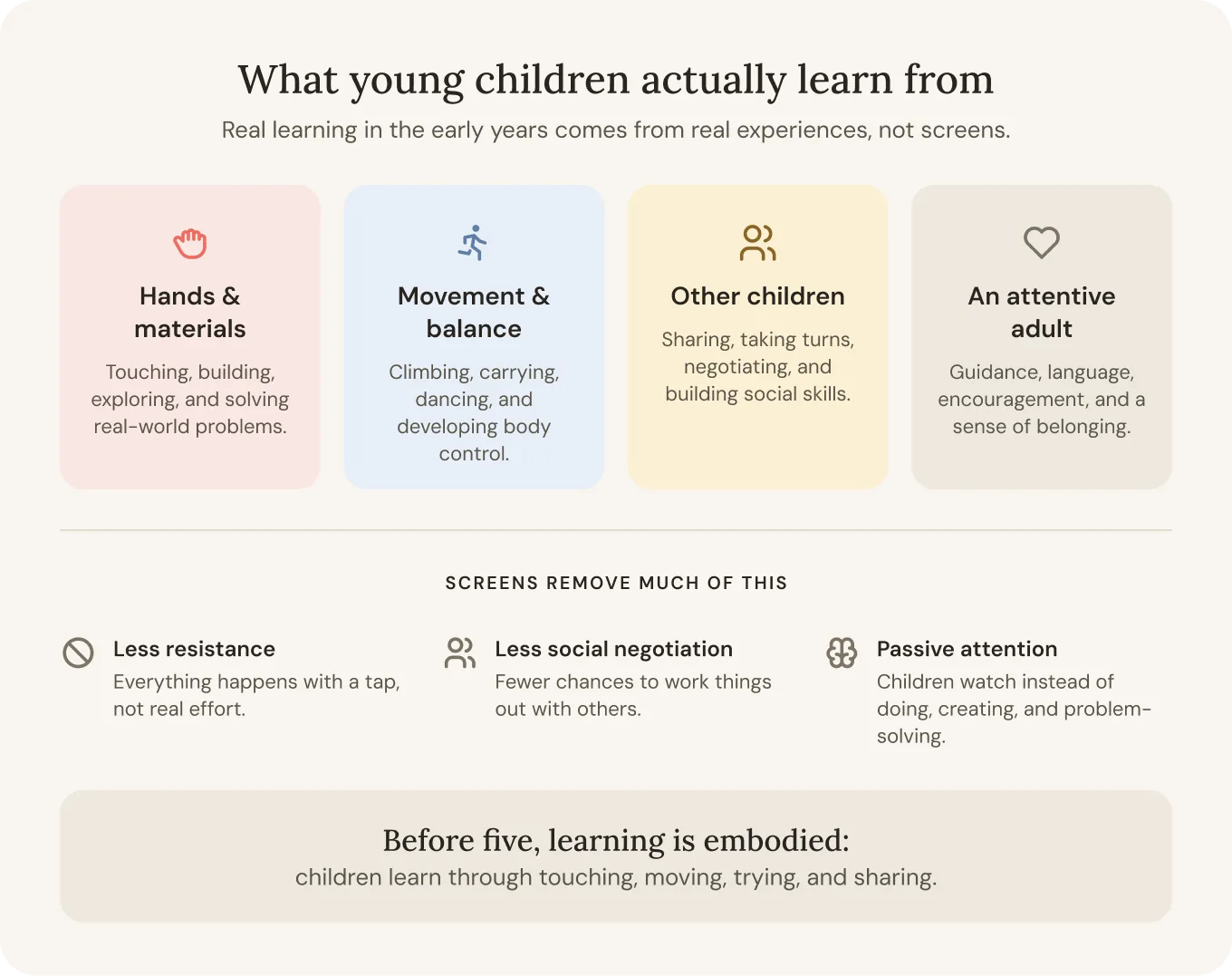
Ask an early childhood educator what children under five need most and you will hear versions of the same answer: hands, movement, other children, and an adult who is paying attention. Nobody says a screen. And yet screens keep arriving in early childhood spaces, usually with good intentions and an educational label on the box.
The research community has been unusually clear on this one. The World Health Organization recommends no sedentary screen time at all for children under two, and no more than one hour a day, with less being better, for children ages two to four. The American Academy of Pediatrics draws similar lines: for children under eighteen months, essentially none outside of video calls with family, and an hour or so of high-quality content, watched with an adult, after that. These are not fringe positions. They are the mainstream medical consensus, and they exist because the early years are when the brain builds itself through a very specific kind of input.
What young children actually learn from
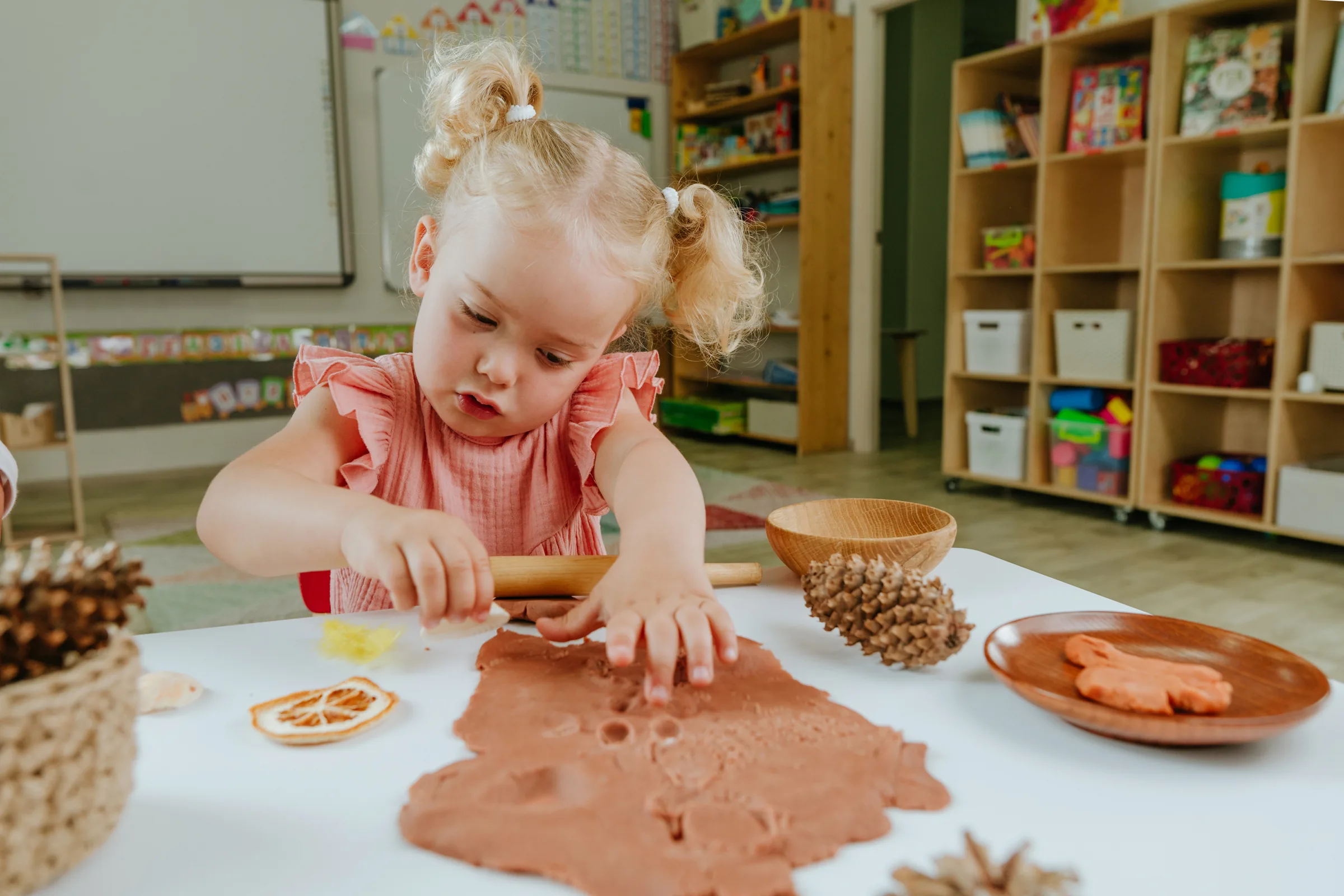
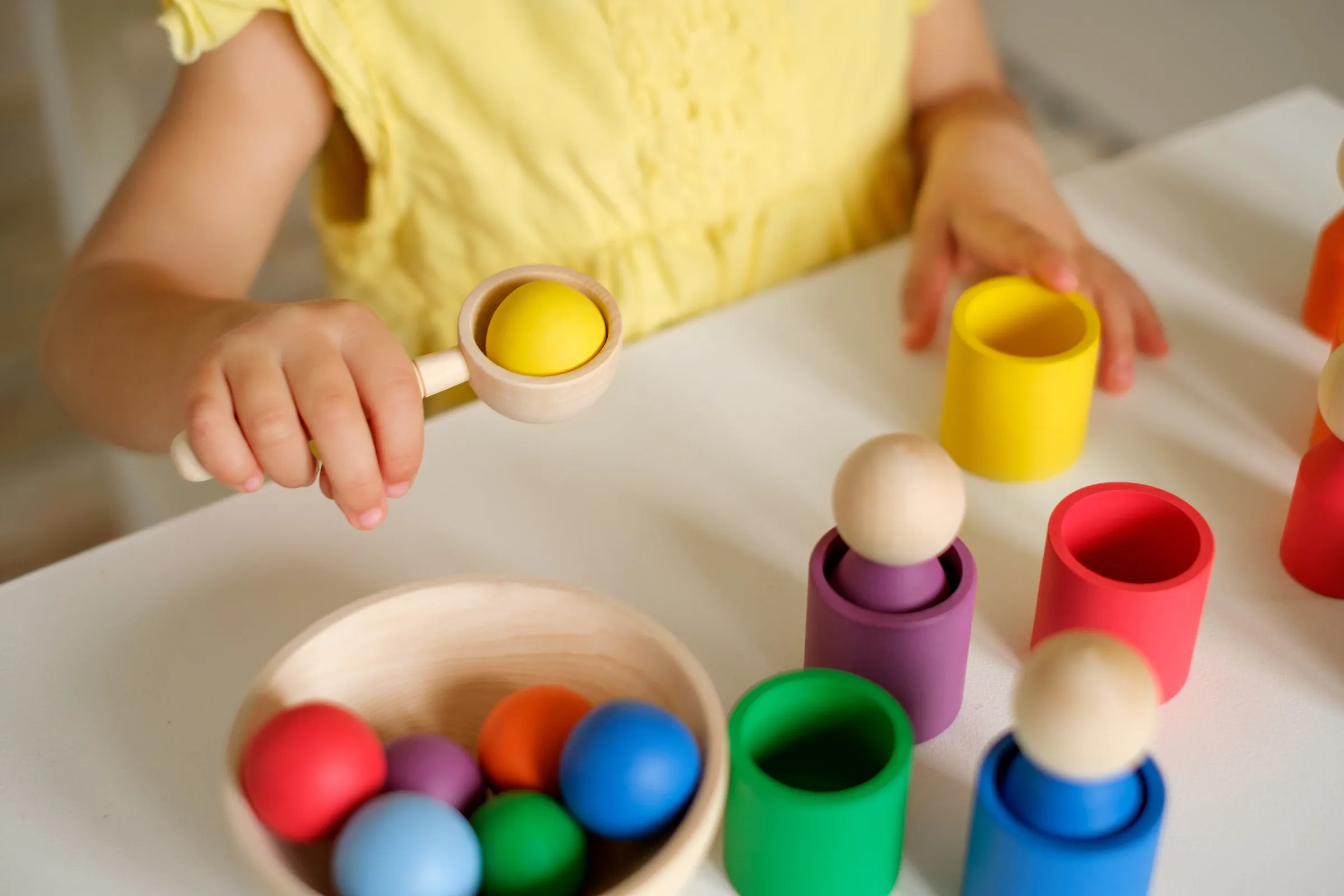
A three-year-old learns by grasping, stacking, pouring, tasting, knocking over, and trying again. The learning is in the resistance of the material: the block that will not balance, the paint that behaves differently on wet paper, the scissors that require both hands and full attention. Developmental psychologists call this embodied learning, and in the years before five it is not one option among several. It is the main channel.
A screen, whatever it displays, removes the resistance. It presents a world that responds instantly, rewards passivity, and asks nothing of the hands, the balance, or the patience. That can be entertaining, and in small doses for older children it can even teach. But for the youngest learners it substitutes a thin signal for a rich one, at the exact age when richness matters most.
There is a social dimension too. The skills that predict how a child will do in kindergarten and beyond, taking turns, reading another child’s face, waiting, negotiating who gets the red crayon, are learned exclusively from other people. No app has ever taught a child to share, because sharing only exists between two children and one object that both of them want.
The educator’s dilemma
None of this is news to educators. Montessori, Reggio Emilia, Waldorf, and play-based approaches were screen-free before screens existed to be free of, and they remain so on principle. Most licensed programs limit screen use tightly, and many prohibit it.
The dilemma is not philosophy. It is logistics. The reason screens creep into classrooms and camps is rarely that anyone believes they are best for children. It is that a good screen-free activity takes real work to produce: the right developmental focus for this exact group, materials that are actually on the shelf, steps that hold the attention of fourteen three-year-olds, and a way to include the child who finds scissors hard or transitions overwhelming. That work usually happens at night, unpaid, from scratch. A video, meanwhile, takes one tap.
In other words, screens win on convenience, never on quality. Which means the honest way to keep early childhood screen-free is not to lecture educators about screen time. It is to make the screen-free option as convenient as the screen.
Planning on a screen so children never learn from one
That is the corner of this problem we work on. Maloo generates complete, printable activity cards shaped to a specific group: their ages, their group size, their materials, their approach, including strategies to bring every child into the activity. The educator does two minutes of describing; the product does the drafting; the result is paper, materials, and play. The only screen in the process is the adult’s, for two minutes, before the day starts.
We hold this as a conviction rather than a feature: the planning happens on a screen, and the learning never does. Children get their hands, their bodies, and each other, which is what the research, the philosophies, and every experienced educator have been saying all along.
What to do with the pressure
If you run a program, the screen-time conversation with families is easier when your position is written down. State it plainly in your handbook: what the guidance says, what your program practices, and what children do instead. Parents choosing between programs increasingly ask, and a clear screen-free answer, backed by the same guidance their pediatrician cites, is a mark of quality they remember.
And if you are the educator holding the line on a hard afternoon with a tempting tablet in the cabinet: the research is on your side, the philosophies are on your side, and the only thing that was ever against you was the planning time. That part, at least, is now solvable.