Child development
What “developmentally appropriate” actually means
The plain-language version, and a thirty-second check for any activity.

“Developmentally appropriate” might be the most-used phrase in early childhood education, and one of the least explained. It appears in handbooks, on curriculum boxes, and in licensing paperwork, usually without anyone saying what it would mean for the activity happening at the table right now. So here is the plain-language version, and a way to check any activity against it in about thirty seconds.
The idea in one sentence
An activity is developmentally appropriate when it asks children to do something they can almost do. Not something they mastered a year ago, which produces boredom, and not something two years ahead of them, which produces frustration and a teacher doing the activity for them. The learning lives in the almost.
That “almost” is different for a two-year-old and a five-year-old in ways that are bigger than most activity books admit. It is not just that older children can do more. It is that they are working on different projects entirely.
What each age is actually working on
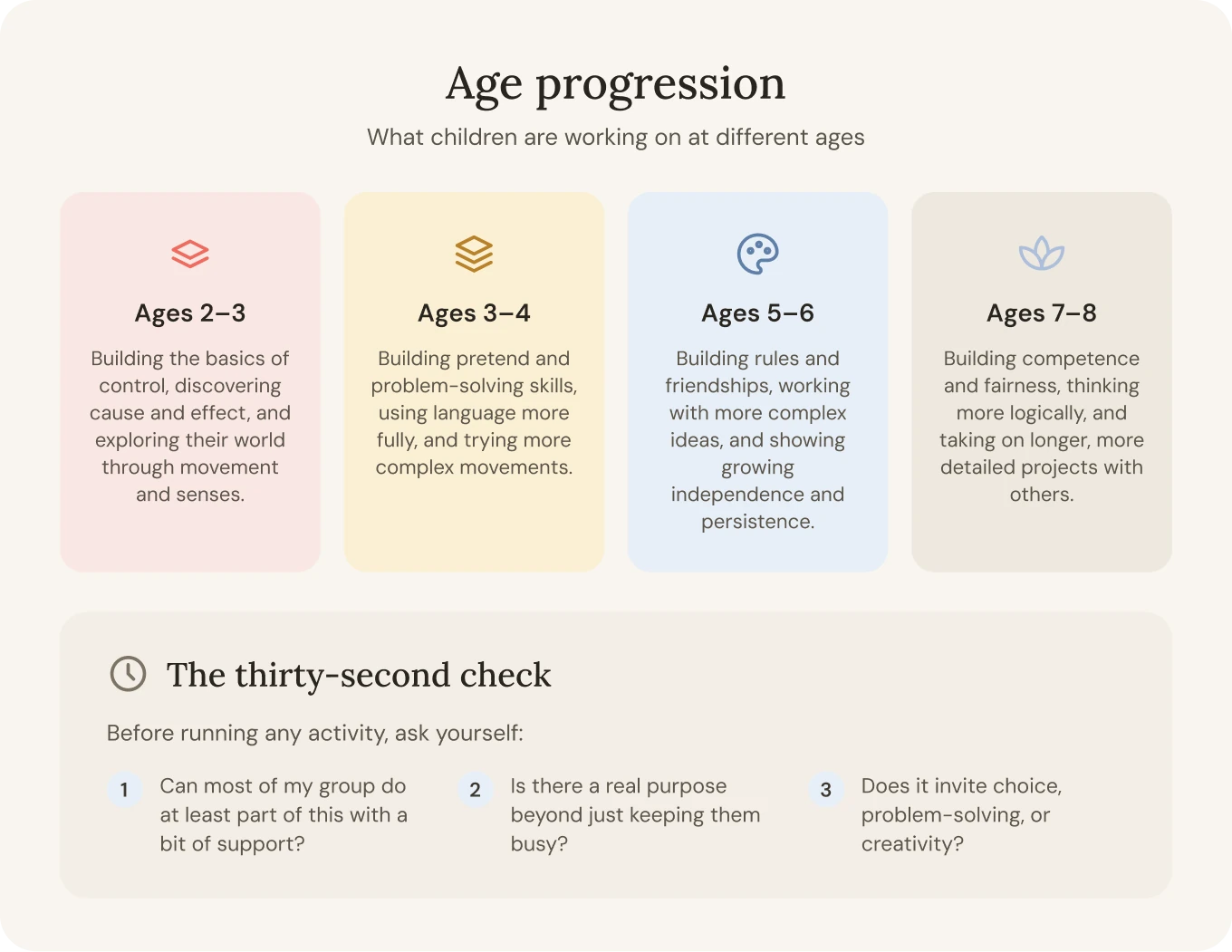
Ages 2 to 3 are building the basics of control: hands that do what they intend, words that get results, and the radical idea that other children exist and have feelings. They learn through repetition that adults find tedious and children find thrilling. Filling and dumping a container forty times is not a failure to progress. It is the curriculum. Appropriate for this age: big movements, chunky materials, parallel play, one-step invitations. Inappropriate: small parts, multi-step sequences, anything that requires waiting long or sharing gracefully.
Ages 3 to 4 are building pretend and pattern: a block can be a phone, a line of animals can be a parade, and a routine can be predicted and even negotiated. Fine motor control is arriving but unevenly. Appropriate: open-ended materials, simple roles, two-step sequences, sorting and matching. Inappropriate: products that must look a certain way, games with real rules and real losers.
Ages 5 to 6 are building rules and friendship: games with turns, projects with steps, jokes with structure, and the intense social mathematics of who sits next to whom. They can plan a little, persist longer, and take pride in skill. Appropriate: multi-step projects, cooperative challenges, early games with rules, responsibility jobs. Inappropriate: assuming the social skills are finished; they are under heavy construction.
Ages 7 to 8 are building competence and fairness: real skills practiced on purpose, rules debated with the passion of constitutional lawyers, and belonging to a group as a project in itself. Appropriate: challenges with visible progress, team structures, activities that produce something they judge as good. Inappropriate: babyish framing; they can smell it instantly.
The thirty-second check
Before running any activity, ask three questions. Can most of my group do the core action with effort but without adult hands taking over? Is the interesting part of the activity the part children do, rather than the setup adults did? And if a child does it differently than planned, is that a problem or a variation? Appropriate activities survive all three questions. Activities designed for the photo rather than the child usually fail the second one.
One more honest marker: a developmentally appropriate activity often looks slightly boring to adults. The four-year-old absorbed in moving water between cups for twenty minutes is doing serious work. The elaborate craft with fourteen adult-prepped components is often doing very little, developmentally, beyond following instructions.
Where the phrase gets misused
Two misuses are worth naming. The first is using “developmentally appropriate” to mean “easy”: stripping challenge out until nothing is almost, everything is already mastered, and the room is calm but nobody is growing. The second is treating age as the only variable. A group’s actual abilities, its languages, its energy on a Tuesday, and which children need a different door into the same activity all matter as much as the birthday math. Age ranges are guides. Your group is the truth.
The planning problem this creates
Here is the honest difficulty: knowing all of this and applying it at 9pm on a Sunday, for a specific group of eleven children with two allergies and a wide range of fine motor skills, are different jobs. The knowledge is the easy part. The application, activity after activity, week after week, is the work that quietly consumes educators’ evenings.
That application problem is what Maloo was built for. It holds the developmental logic above, matched to the four age ranges, and applies it to your actual group: your ages, your group size, your materials, your approach. You describe the session; it drafts an activity aimed at the almost, with adaptations by age and inclusion strategies included, printed and ready. Your judgment stays the final check, as it should. The Sunday evening goes back to you.