Behind Maloo
How Maloo shapes an activity to your classroom
The honest tour from “describe your group” to a printed card.

Every other article on this site is about children and teaching. This one is about the tool, because educators keep asking the same fair question in different words: what actually happens between “I describe my group” and “a finished card comes out”? Here is the honest tour.
It starts with what you told us once
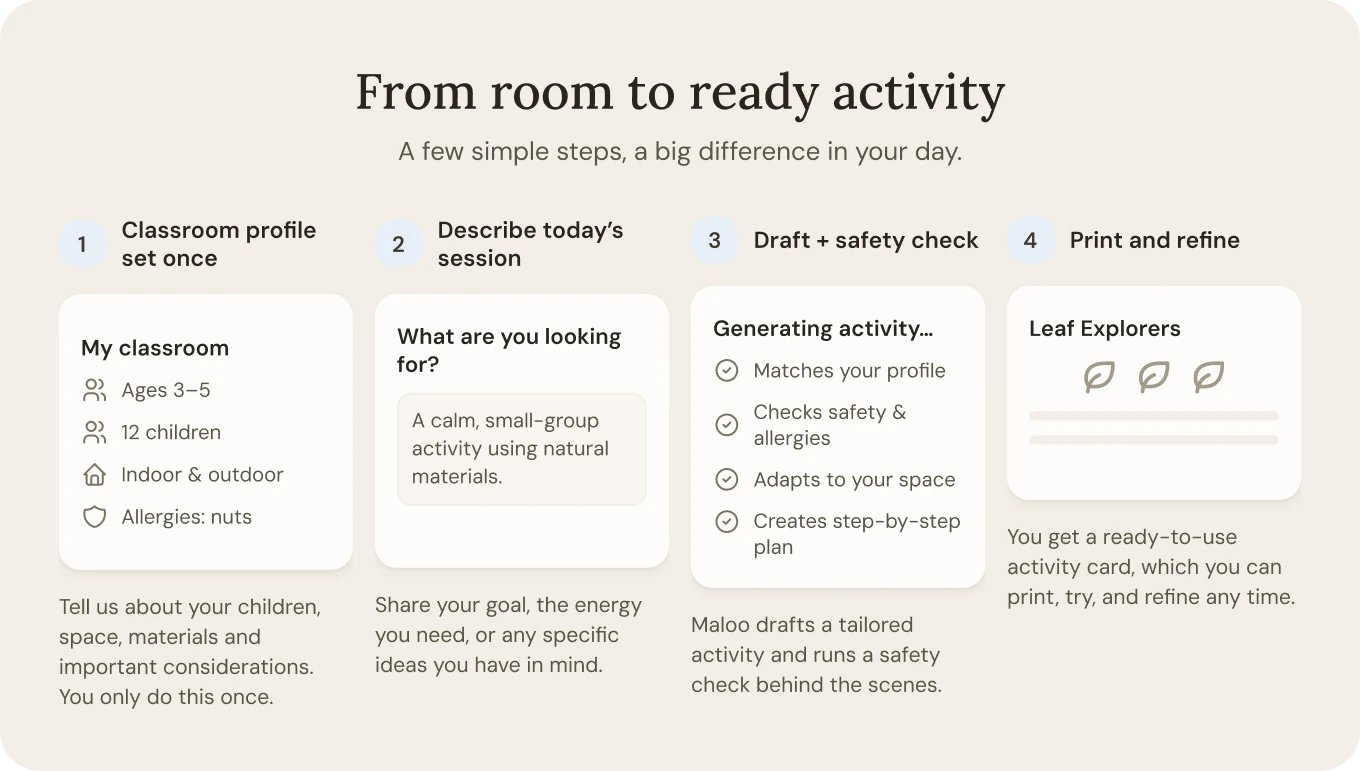
The difference between a generic activity and one that fits is context, and context is exactly what generic tools make you retype forever. So Maloo’s foundation is the classroom profile, set up once in about two minutes: your ages, your group size, your space, how you work, the materials you actually keep on hand, and, importantly, anything to always avoid: the latex allergy, the glitter ban, the cultural considerations that are simply how your room runs. The profile holds no information about any individual child, ever; it describes your group in aggregate, and the fields will warn you if something you type looks like a name. That is a deliberate wall, not an oversight.
Then you describe today
A profile describes your room in general. A session is specific: how much time you have, what energy the group has, what is on the shelf this week, whether you want calm or movement or teamwork. That is the two-minute form, and it is deliberately short because the profile already did the heavy lifting. Tuesday-after-a-fire-drill and Friday-before-a-holiday are different rooms; the form is how Maloo knows which one it is writing for.
The drafting, honestly described
Maloo is built on the same class of technology as general-purpose AI chatbots, but it includes what a general chatbot does not have: a classroom profile it never forgets, prompts refined over months of testing with real educators, an independent second check of every card against a child-safety rubric before you see it, and a print-ready card at the end. When you tap generate, your profile and session answers are assembled into a detailed brief, and a complete activity is drafted against it: the activity itself, materials from your list, setup, step-by-step flow, adaptations by age, inclusion strategies organized by access barrier, extension ideas, and safety considerations written for the age you selected.
The check you never see
Before any card reaches you, it is independently checked against a child-safety rubric, including age-appropriateness, materials, and the restrictions in your profile, such as allergies. A card that lists a material you excluded, or hands small parts to a two-year-old, or writes safety notes that ignore what the activity actually uses, does not get shown to you. It gets regenerated. You only ever see cards that passed. Most of the time this check is invisible, which is the point; the times it quietly rejects a draft are the times it earned its keep.
And the part every educator already knows, printed on every card because it is true: no tool replaces your judgment. You know your children, your room, and your day. Every activity assumes continuous adult supervision, and you are always the final reviewer of whether an activity suits the children in your care.
Almost right is a feature, not a failure
Sometimes a card is close but not quite: right activity, too long; right idea, too rowdy for today. That is what refine is for. One tap makes it calmer, shorter, more challenging, or heavier on movement, and Maloo adjusts the same activity instead of starting over, keeping what already works. The refined version saves as its own card with the original untouched, so experimenting costs nothing.
It ends as paper
The last step is the one the whole product is named for: the card becomes a printable PDF, in color or in a black-and-white version that photocopies cleanly, and the screen’s job is over. Children never see Maloo. They see sponges, paint, blocks, and a teacher who has a plan and her evening back. We hold that as a conviction rather than a feature: the planning happens on a screen. The learning never does.
Why we built it this way
Every design choice above came from the same place: watching educators spend nights doing work that deserved better tools, without ever believing a screen belonged in front of their children. The profile exists because re-explaining your room forever is disrespectful of your time. The safety check exists because a children’s product should be checked by more than hope. The paper exists because that is where childhood happens.
The first card is free, every month, no card required: describe your group at heymaloo.com and see what comes back. Judge it the way you judge everything: by whether it works in your room.