For programs
Setting one quality bar across every room
How strong programs keep every classroom consistently good, without flattening them.

Walk through a multi-room program on any weekday morning and you can usually feel it: one room is mid-activity, absorbed and humming; another is improvising; a third is running the same five activities it ran in March because they are safe and known. Nobody planned this unevenness. It is what happens by default when activity quality depends on whichever educator happens to be planning, with whatever time they happened to have last night.
Directors know this problem intimately, because they are the ones who hear about it: from the parent who notices one room does “so much more,” from the licensor who asks how curriculum is implemented consistently, from the new hire who asks what the program’s standard actually is and receives, in many programs, a shrug and a binder from 2019.
Why the usual fixes underdeliver
The instinctive fixes all cost more than they return. Writing an internal curriculum manual takes a summer, is outdated by winter, and mostly goes unread. Boxed curriculum products cost thousands of dollars a year and solve consistency by flattening it: every room does the same thing, whether or not it fits the actual children in it. And relying on your strongest educator to lift the others works right up until she leaves, taking the program’s real curriculum with her in her head.
The uncomfortable truth underneath: consistency and flexibility pull against each other. Programs want every room reliably good and every room fitted to its actual group. A manual gives you the first at the cost of the second. Pure educator autonomy gives you the second at the cost of the first.
What the strong programs actually do
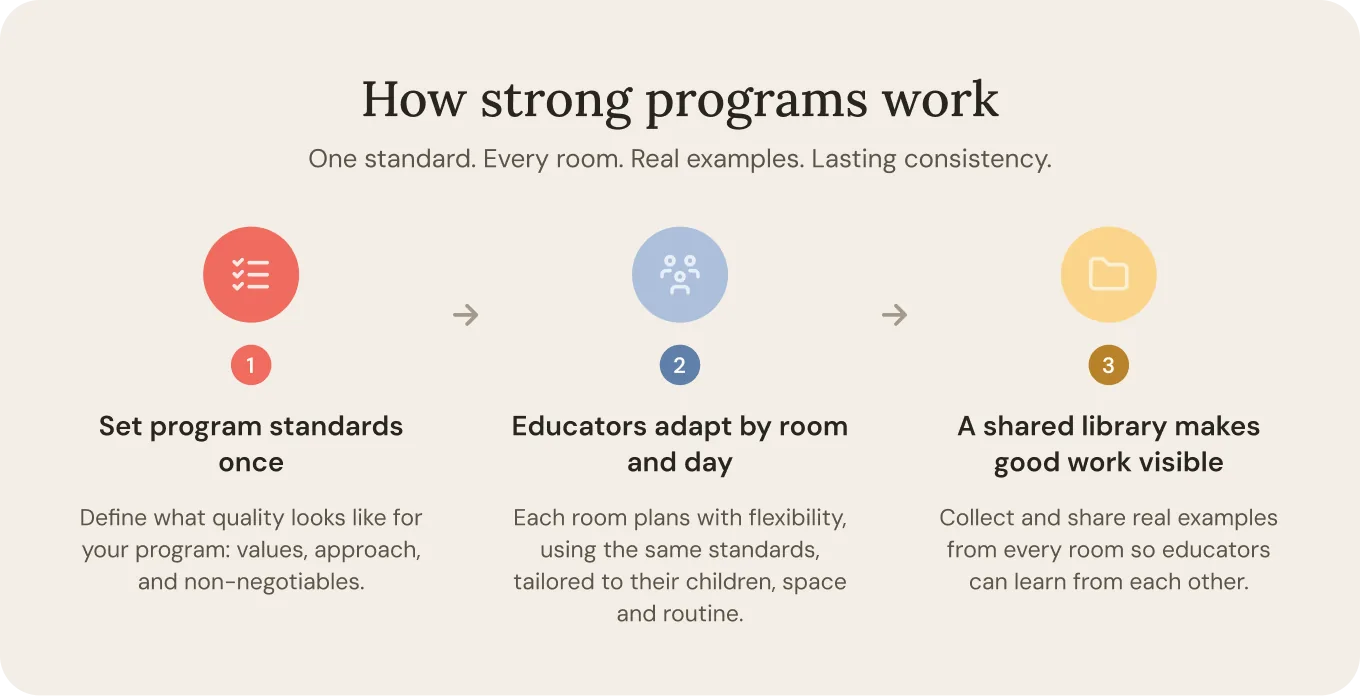
Programs that thread this needle share a pattern, whatever tools they use. They define the program-level constants once: the approach and values, the quality bar for what an activity must include, the non-negotiables like allergy rules and supervision practices. Then they push the room-level variables down to educators: this group, this day, this energy, these materials. Consistency lives at the level of standards; flexibility lives at the level of sessions. The director’s job stops being inspecting every plan and becomes maintaining the standard everyone plans from.
The second thing they do is make good work visible across rooms. When one educator finds an activity that lands, the strong program has a way for the next room to find it, instead of every educator mining alone. Over years, this becomes the program’s real asset: a bank of what works here, with these families, in these seasons, that survives any individual staff departure.
And the third: they onboard to the standard, not to the building. A new educator’s first week in a strong program includes what good looks like here, in concrete examples, not just where the supply closet is.
The honest cost
None of that is conceptually hard. All of it is expensive in the currency programs have least of: director attention and educator evenings. Which is why the pattern is rare, and why “our quality depends on who you get” remains the honest description of many well-intentioned programs.
Where Maloo fits
This is the problem Maloo’s Program plan was built around. The program profile is the constants, set once by the director: approach, values, ages served, anything to always avoid. Every activity any educator generates is shaped by that profile automatically, so every room plans from the same starting point without anyone writing a manual. Educators keep the session-level freedom that makes activities fit their actual group: their time, their energy, their materials, their day. The shared program library is the bank: cards educators choose to share become the program’s collection, visible to every room, and it stays when staff moves on. And a new hire’s first activity is already shaped by your program’s standard, on day one, because the standard lives in the system rather than in a veteran’s head.
One shared profile, every classroom, without flattening any of them. That is the bar, held everywhere, at $199 a month instead of a curriculum budget line.
If you lead a program and this is the itch you have been scratching with binders and hope, a demo takes thirty minutes and runs on your actual program, not a canned one. Bring your hardest room.